A brief history
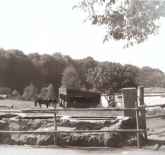
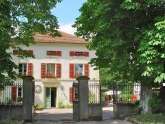
Association Ecolonie is a residential and working community, now often referred to as an eco-village, founded in 1989, primarily by a group of Dutch and German individuals deeply committed to environmental issues. They named it the European Ecological Centre Ecolonie. In that year, they purchased a 7-hectare property with buildings known as Thietry. From 1945 to 1985, this site had served as a children’s holiday camp for the children of miners. From that point onward, the development of Ecolonie can best be described through a metaphor.
Following its conception (the purchase), Ecolonie underwent a nine-year ‘gestation period.’ In 1998, the ‘child Ecolonie’ was effectively born, entering a 12-year period during which it was nurtured and provided for. Its right to exist was secured during this time, thanks in large part to the efforts of thousands of volunteers (referred to as temporary participants) and financial contributions (loans and donations) from various sources. Whereas in 1989 the association had 7 hectares of land with buildings, by 2012 Ecolonie had grown to encompass 40 hectares of land (forests, meadows, and lakes), including buildings such as the goat farm. Since 2016, we have been fortunate to lease an additional 25 hectares of hay meadows from a supportive couple.
From one-way to a two-way interaction
From 2012 onwards, it gradually became clear that Ecolonie was increasingly gaining a material basis for its existence. It seemed to be developing into a place that serves everyone who wishes to learn something, whether in a spiritual, social, or material sense. The one-way traffic, where the individual serves the development of the whole, was increasingly transforming into a two-way interaction. Ecolonie can now more and more be seen as a training ground for those who wish to acquire artisanal skills. In this context, we speak of a workshop for artisanal skills, where the central focus is on the practice of what we call the EcoZeN way of life.
Ecolonie develops very slowly, organically, and therefore sustainably, into a place whose defining contours, who we are and what we want, gradually become visible. This is not a random process but is based on a vision formulated at the beginning of this century, which continues to be refined. This development has been made possible, among other things, because residents and permanent participants have received no salaries since the inception of Ecolonie, only pocket money and allowances for clothing. In this sense, Ecolonie has long ceased to be a mere material experiment, as in practice, after all these years, it demonstrates what can be achieved when everyone shares the same focus (vision) and is willing to make ‘sacrifices’ for its realization. Of course, these are only sacrifices from the perspective of the conventional way of life.
Curious about the history and vision of Ecolonie? Then join the lecture every Tuesday afternoon during the high season, from around 4:30 to 5:30 PM. You can sign up for it on the notice board at the Courtyard.
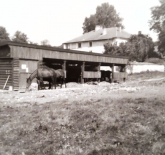
The former horse stable, now our agricultural barn, in the foreground with the Château in the background in 1973.